 ×
×
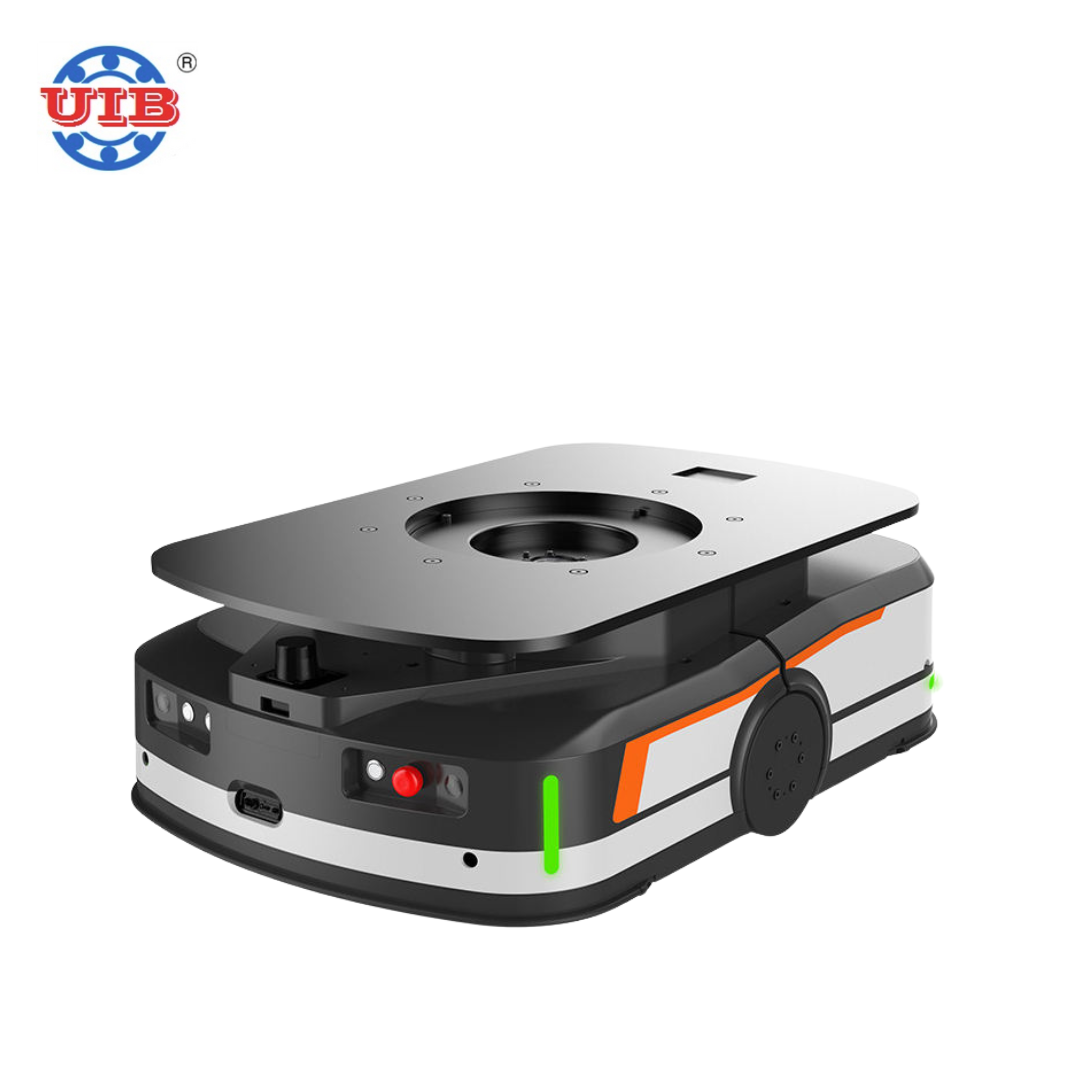
In the wave of industrial automation, logistics handling equipment is evolving from manual-driven to intelligent and autonomous. As a core flexible logistics solution, AGV forklift robots are gradually replacing traditional forklifts with their precision control, efficient collaboration and reliable safety. They have become a necessity in automotive manufacturing, warehousing logistics, pharmaceutical cold chain and other sectors, redefining the handling efficiency of modern industry.
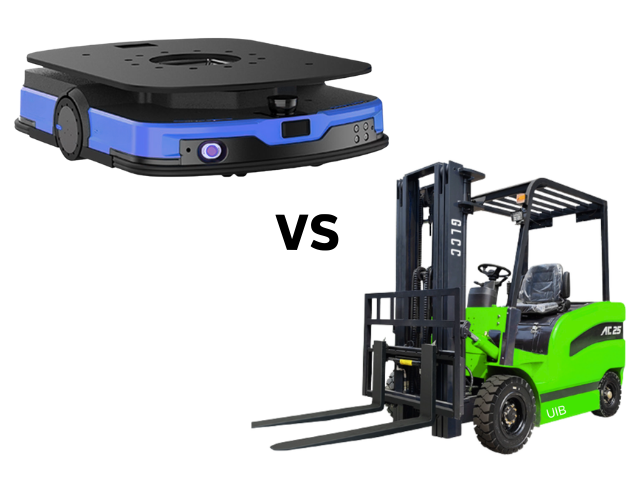
Traditional forklifts rely on manual operation, making them incompatible with large-scale intelligent production in terms of efficiency, safety and cost. AGV forklift robots achieve all-round upgrades through technological innovation, with the following distinct differences:
Traditional forklifts require professional drivers for full-time operation, with efficiency greatly affected by operator skills, fatigue and shift handovers, making 24/7 continuous operation impossible. Equipped with laser SLAM navigation and visual recognition technology, AGV forklift robots can autonomously build maps, plan optimal paths, and complete the entire process of material picking, transferring and stacking without human intervention. With a positioning accuracy of ±10mm, they are suitable for narrow aisles (≤2m) and high-level shelves (≥6m), while multi-machine collaboration systems enable efficient batch task processing.
Traditional forklifts only have basic protection such as rearview mirrors and seat belts, with accident rates closely linked to operational standards, leading to high risks of collisions and overturns. AGV forklift robots integrate multiple protection devices including laser radar and ultrasonic sensors, enabling real-time obstacle avoidance and automatic braking. They comply with international safety standards such as CE and ISO 3691-4, and are suitable for hazardous working environments with extreme temperatures and toxic substances.
Traditional forklifts have low initial procurement costs, but require continuous expenditure on driver salaries and training, resulting in high long-term operational costs. Although AGV forklift robots have higher initial investment, they can replace 3-5 manual workers and operate 24/7, reducing labor costs by over 65%. With lower energy consumption and maintenance costs, they achieve ROI within 1-2 years in large-scale applications. Meanwhile, data-driven management reduces material waste and improves warehouse utilization.
Traditional forklifts are suitable for open outdoor and complex terrain scenarios, but lack adaptability in standardized environments such as clean workshops and automated warehouses. AGV forklift robots can seamlessly integrate with WMS, MES and ERP systems, realizing full-process visualization of material flow. They are precisely adapted to intelligent warehouses, production line connection and pharmaceutical cold chain scenarios, capable of stable operation in cold storage below -10℃ and meeting high cleanliness requirements in the semiconductor industry.
The core competitiveness of AGV forklift robots stems from technological innovation, building a comprehensive advantage from navigation to system collaboration:
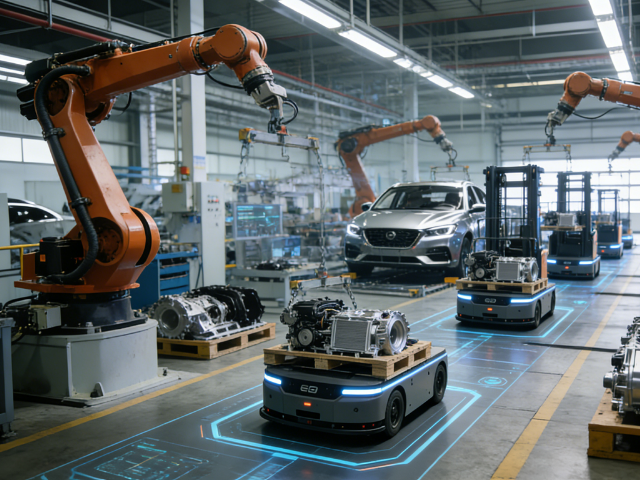
Flexible Upgrade of Navigation TechnologyBreaking free from the constraints of traditional magnetic stripe and QR code navigation, laser SLAM navigation enables autonomous positioning and mapping in dynamic environments without pre-set tracks. Path adjustments are flexible and convenient, adapting to the dynamic optimization needs of production layouts. The multi-navigation fusion solution (laser + inertial + vision) further improves adaptability in complex environments, ensuring stable operation even without network connectivity.
Advanced Intelligent Collaboration CapabilityEquipped with a Robot Control System (RCS), AGV forklift robots realize multi-machine task allocation, path optimization and obstacle avoidance collaboration, avoiding congestion and improving overall efficiency. By linking with automated storage and retrieval systems, conveyors and hoists, they create a fully automated logistics chain from warehousing to production line to outbound delivery, ensuring just-in-time (JIT) material supply.
Modular and Customizable DesignAdopting a modular architecture, AGV forklift robots can be quickly adapted to different scenarios according to load requirements (500kg–5t) and operational functions (stacking, handling, clamping). Changing attachments enables handling of irregular materials. Customized development is supported to provide exclusive solutions for special needs such as chemical explosion protection, pharmaceutical sterility and high-level stacking, with strong scalability.
In automotive parts manufacturing and e-commerce logistics, AGV forklift robots have demonstrated significant cost reduction and efficiency improvement value. After introducing AGV forklift robots, a leading automotive parts enterprise realized fully automated handling from production lines to warehouses, improving operational efficiency by over 40%. Real-time material data visualization completely solved the problem of inventory discrepancies. An e-commerce warehouse increased shelf height to 8.5m using AGV high-level stacking forklifts, improving warehouse utilization by 60% and easily coping with order peak pressures.
With the integration of 5G, AI and digital twin technologies, AGV forklift robots are evolving from simple handling tools to intelligent logistics nodes, empowering enterprises in digital transformation. In the future, driven by rising labor costs and growing demand for automation, AGV forklift robots will gradually replace traditional forklifts, becoming the core engine for intelligent upgrading of industrial logistics and promoting the development of global manufacturing towards flexibility, efficiency and green sustainability
 Hot News
UIB Xiamen is a 10-year factory supplying custom conveyor, sorting machine, forklift & material handling machinery for logistics, cold chain & manufacturing. Free customized solution available.
Room 1409, SM International Center, Xingshan Road, Huli District, Xiamen City, Fujian Province, China.
Copyright © 2025 by UIB (Xiamen) Bearing Co., Ltd. Privacy Policy

 EN
EN